Cervical Spine
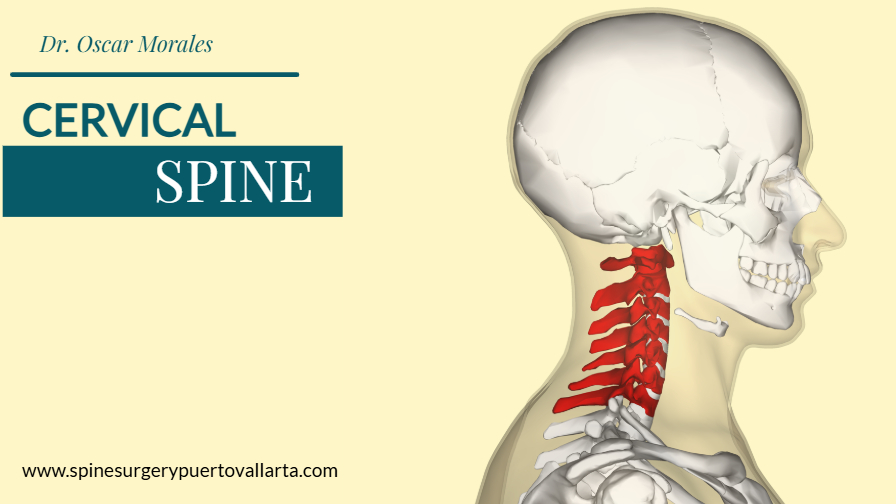
Your cervical spine consists of the first seven vertebrae in your spine. It provides support for the weight of your head, surrounds and protects your spinal cord, and allows for a wide range of head motions.
Your seven cervical vertebrae (C1 to C7) are connected at the back of the bone by a type of joint (called facet joints), which allow for the forward, backward and twisting motions of your neck.

Many conditions affect this area.
Spine, including neck pain, arthritis, degenerative bone and disk disease, and stenosis.
Your cervical spine is also surrounded by muscles, nerves, tendons and ligaments. “Shock-absorbing” disks, called intervertebral disks, are positioned between each vertebra. Your spinal cord runs through the center of your entire spine.
Your spinal cord sends and receives messages from your brain, which controls all aspects of your body’s functions.
What does the cervical spine do?
Your cervical spine has several functions, including:
1. Protecting your spinal cord. The nerves of your spinal cord pass through a large hole (called the vertebral foramen) that passes through the center of all of your vertebrae — from the base of your skull through the cervical vertebrae, the thoracic (middle back) vertebrae and ending between the first and second lumbar (lower back) vertebrae. Taken together, all the stacked vertebrae of your spine form a protective central canal that protects your spinal cord.
2. Supporting your head and allowing movement. Your cervical spine supports the weight of your head (average weight of 10 to 13 pounds). It also allows your head and neck to tilt forward (flexion), backward (extension), turn from side to side (rotation) or bend to one side (ear-to-shoulder; lateral flexion).
3. Providing a safe passageway for vertebral arteries. Small holes in cervical spine vertebrae C1 to C6 provide a protective pathway for vertebral arteries to carry blood to your brain.
This is the only section of vertebrae in the entire spine that contains holes in the bone to allow arteries to pass through.
What diseases and disorders affect your cervical spine?
Many diseases and conditions result from problems in the cervical spine and the surrounding soft tissues and nerves.
These include:
Cervical radiculopathy. This condition arises when a cervical nerve is pinched by cervical vertebrae. You may experience tingling, numbness, weakness and pain. Symptoms may remain local or can spread to your entire arm, hand and fingers. Cervical radiculopathy is also called a pinched nerve or cervical nerve compression.
Neck pain. Neck pain is a common symptom of many different injuries and medical conditions. Common causes include degenerative conditions (osteoarthritis, spinal stenosis, herniated disk, pinched nerve), whiplash, mental stress, physical strain, poor posture, growths (tumors, cysts, bone spurs), meningitis, rheumatoid arthritis and cancer.
Cervical degenerative disk disease. Cervical degenerative disk disease occurs when the disks in your cervical spine wear down.
Herniated disk. This condition is a tear or leak to the disks that provide a cushion between vertebrae. Intervertebral disks allow you to bend and move with ease.
Bone spurs in your cervical spine (cervical osteophytes). Bone spurs are growths that occur on any of the seven vertebrae in your cervical spine.
Cervical spondylosis. Cervical spondylosis, also called arthritis of the neck, is the age-related slow degeneration of your disks and joints in your cervical spine
Cervical spinal cord injury. A cervical spinal cord injury is an injury to your cervical vertebrae. Most spinal cord injuries are the result of a sudden, traumatic blow to the vertebrae.
Cervical spinal fracture. A fracture to the bones of your spine can result from compression (often from minor trauma in a person with osteoporosis) or be a burst fracture (vertebra that’s crushed in all directions) or a fracture-dislocation (mostly from vehicle accidents or falls from heights).
Cervical spinal cord compression (cervical spondylotic myelopathy). This is a condition in which there’s pressure on your spinal cord in the cervical area of your spine. One of the most common causes is wear and tear on the bones of your spine, a condition called osteoarthritis.
Cervical stenosis. This condition occurs when your spinal canal in the cervical spine area narrows. Less space within your cervical spine reduces the amount of space available for your spinal cord and nerves that branch off the spinal cord. A tightened space can cause your spinal cord or nerves to become irritated, compressed or pinched.
Cervical spinal tumor and cancer. Tumors are abnormal growths of tissue inside your spinal column. They can either be noncancerous (benign) or cancerous (malignant).
Meningitis. Meningitis is an infection of the meninges. The meninges are a protective lining around your brain and spinal cord.
Osteomyelitis. Osteomyelitis is a bacterial or fungal infection of the bone, in this case, the vertebrae of your spine. If left untreated, it can lead to the death of vertebrae.